Sections of this topic

When you step onto a casino floor or browse an online gaming site, you are surrounded by thousands of slot machines. While they all look different, every single one is governed by a specific mathematical setting known as Return to Player (RTP).
If you have ever wondered why some games seem to pay out frequently while others feel like a “black hole” for your bankroll, the answer usually lies in the RTP. Understanding this concept is the first step toward becoming a more informed player.
What is RTP?
Return to Player (RTP) is a term used to describe the percentage of all wagered money a slot machine will pay back to players over time.
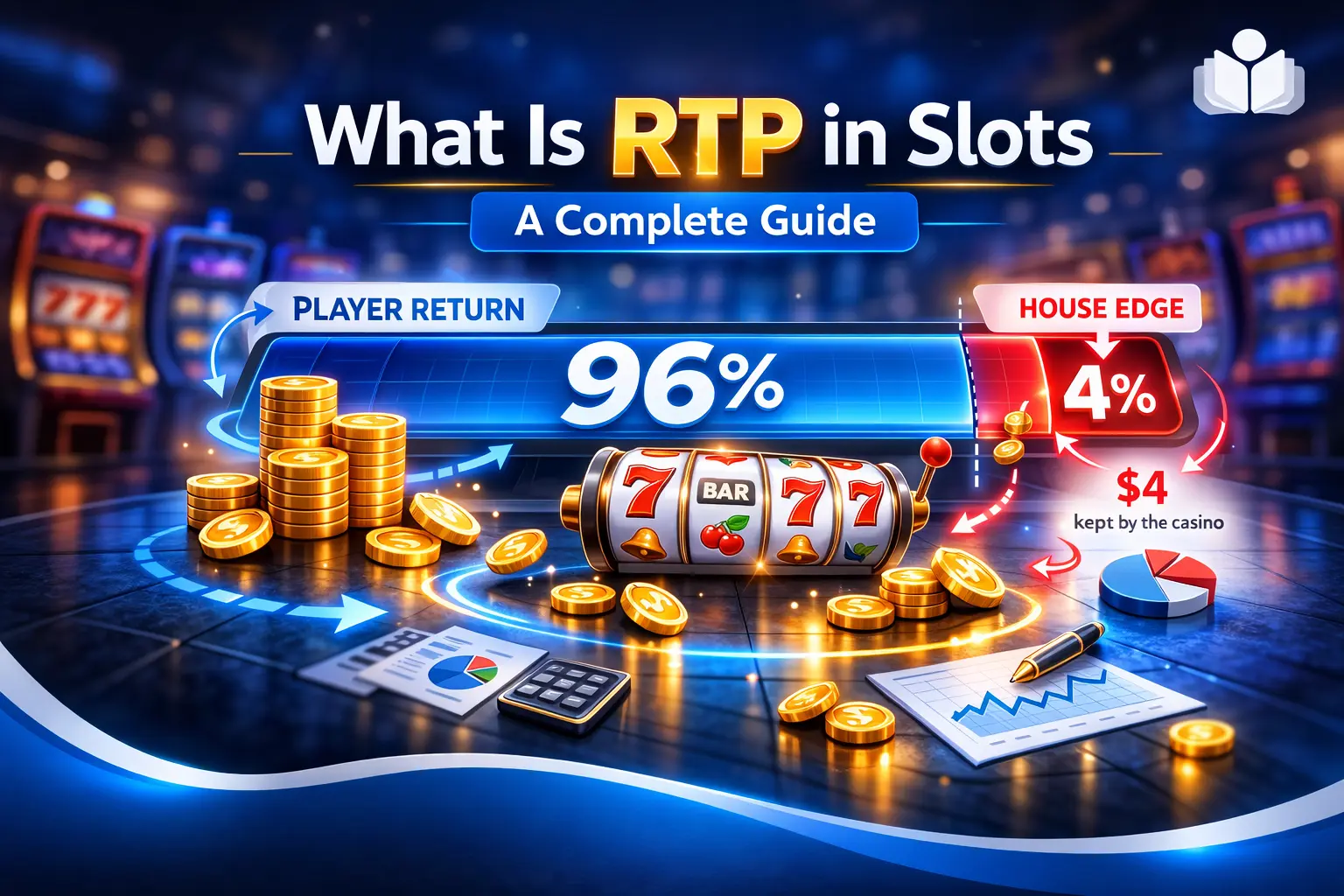
Think of it as the mathematical opposite of the house edge. If a slot has a house edge of 4%, the RTP is 96%. It represents the theoretical reward you can expect from a game, though it is vital to understand that this figure is calculated over millions of spins, not a single session.
How the Math Works
To understand the scale of RTP, imagine a slot machine with a 95% RTP.
- If players collectively wager $1,000,000 on that machine, the game is programmed to eventually return $950,000 in winnings.
- The remaining $50,000 (5%) is kept by the casino to cover operating costs and generate profit.
The Theory vs. The Reality
The biggest mistake beginners make is assuming RTP applies to their specific session. If you sit down with $100 on a 96% RTP slot, you might expect to leave with $96. This is rarely what happens.
The Long Run
RTP is a “long-term” average. Game developers calculate this number by simulating millions, or even billions, of spins in a laboratory setting. In the short term—meaning the few hundred or thousand spins you might play in an evening—anything can happen.
This discrepancy is what makes gambling possible. In a short window, you might hit a massive jackpot (resulting in an RTP of 1,000% for that session) or lose your entire balance (an RTP of 0%). Over the course of the machine’s entire lifespan, however, those peaks and valleys smooth out to meet the programmed percentage.
Why RTP Matters to You
Even though RTP doesn’t guarantee a specific result for your Tuesday night session, it is still the most valuable tool for comparing games.
Generally, slots fall into three categories:
- Low RTP: Below 93% (Typically found in physical land-based casinos or progressive jackpot slots).
- Average RTP: 94% to 96% (The standard for most modern online slots).
- High RTP: 97% and above (Considered player-friendly games).
By choosing a game with a higher RTP, you are mathematically reducing the “cost” of your entertainment over time. You are essentially giving the house a smaller advantage.
RTP and Volatility: The Missing Piece
To fully understand RTP, you have to pair it with Volatility (sometimes called Variance). While RTP tells you how much a game pays back, volatility tells you how often and in what size those payments arrive.
Low Volatility Slots
These games pay out frequently but in smaller amounts. They are designed to keep your balance steady, allowing for longer play sessions. A high RTP combined with low volatility usually means a “safer” game for those who want to play for a long time without risking a quick “bust.”
High Volatility Slots
These games are the “home run” hitters. You might go many spins without winning anything at all, but when a win does hit, it tends to be much larger. These games can be frustrating because even if the RTP is high (e.g., 98%), you could lose your entire budget before the game’s math has a chance to “repay” you.
How to Find a Slot’s RTP
In the modern era of gaming, transparency is a standard requirement for most regulated jurisdictions. You don’t have to guess what a game’s return is; the information is usually available if you know where to look.
- The Help File: Most online slots include an “i” (info) or “?” (help) button. Clicking this opens the game rules, and the RTP is typically listed at the bottom of the document.
- Casino Information Pages: Many reputable sites provide a master list of all their games and their respective payout percentages.
- Developer Websites: You can often visit the website of the company that created the game (such as NetEnt, Microgaming, or IGT) to find the official technical specifications.
Common Myths About RTP
Because slots are based on luck, many myths have sprouted up around how they pay out. Let’s clear a few up.
Myth 1: A slot is “due” for a win
If a 97% RTP slot hasn’t paid out in hours, people often think it is “due” to hit a big win to catch up to its average. This is false. Every single spin is an independent event controlled by a Random Number Generator (RNG). The math balances out over millions of spins, not over a single afternoon.
Myth 2: Casinos can change RTP with a switch
In regulated markets, casinos cannot simply flip a switch to lower the RTP when the building gets busy. The RTP is part of the game’s core code, which is verified by third-party testing agencies. While some developers offer “variable RTP” versions of games to casinos, the specific percentage must be clearly stated in the game’s help file.
Myth 3: High RTP means you will win
RTP is not a “win probability.” A game could have a 99% RTP, but if it is highly volatile, you could still lose your entire bankroll very quickly. Always remember that RTP is a measure of loss prevention over the long term, not a guarantee of profit.
Summary Checklist for Players
When you are looking at a new slot game, use this mental checklist to evaluate its value:
- Check the RTP: Aim for 96% or higher for the best statistical value.
- Check the Volatility: Does the frequency of wins match your playstyle?
- Ignore “Hot” or “Cold” streaks: Remember that the RTP is a long-term average, and the next spin is always random.
- Read the Rules: Some games require you to play at a certain bet level (like “Max Bet”) to unlock the full RTP, especially in games with progressive jackpots.
Understanding Return to Player doesn’t change the fact that slots are games of chance. However, it does give you the power to choose games that offer the best value for your money. By picking higher RTP games, you ensure that your entertainment budget lasts longer, giving you more opportunities to enjoy the game.
Must be 21+ to participate. Gambling problem? Call 1-800-GAMBLER.
DISCLAIMER: The information on this site is for entertainment purposes only. Online gambling comes with risks. There’s no guarantee of financial gain, so you should only gamble with what you can afford to lose.
While gambling can be fun, it can also be addictive. If you or anyone you know suffers from a gambling addiction problem, we recommend that you call the National Gambling Helpline at 1-800-522-4700 to speak with an advisor. Please remember that our guides and all gambling sites are only for people who are 21+. Also, check with local laws to find out if online gambling is legal in your area.
For free online gambling addiction resources, visit these organizations: