Sections of this topic

If you have ever spent time playing slot machines, you might have noticed that some games seem to hand out small wins every few spins, while others can go for a long time without paying anything at all before suddenly hitting a massive jackpot. This difference isn’t a coincidence; it is a core part of the game’s design called volatility.
Understanding volatility is one of the most important steps in becoming a more informed player. It helps you manage your expectations, choose games that fit your personality, and plan your budget more effectively. If you’re exploring different types of online slots, knowing how volatility works can significantly improve your overall experience.
What is Slot Volatility?
In the simplest terms, volatility (often referred to as variance) describes the level of risk associated with a specific slot game. It tells you two main things: how often you are likely to win and how large those wins are likely to be.
Think of it as the “personality” of the slot machine. Some games are steady and predictable, while others are wild and unpredictable. While every spin is determined by a Random Number Generator (RNG), the volatility setting dictates the mathematical distribution of those random results over thousands of spins.
The Three Main Levels of Volatility
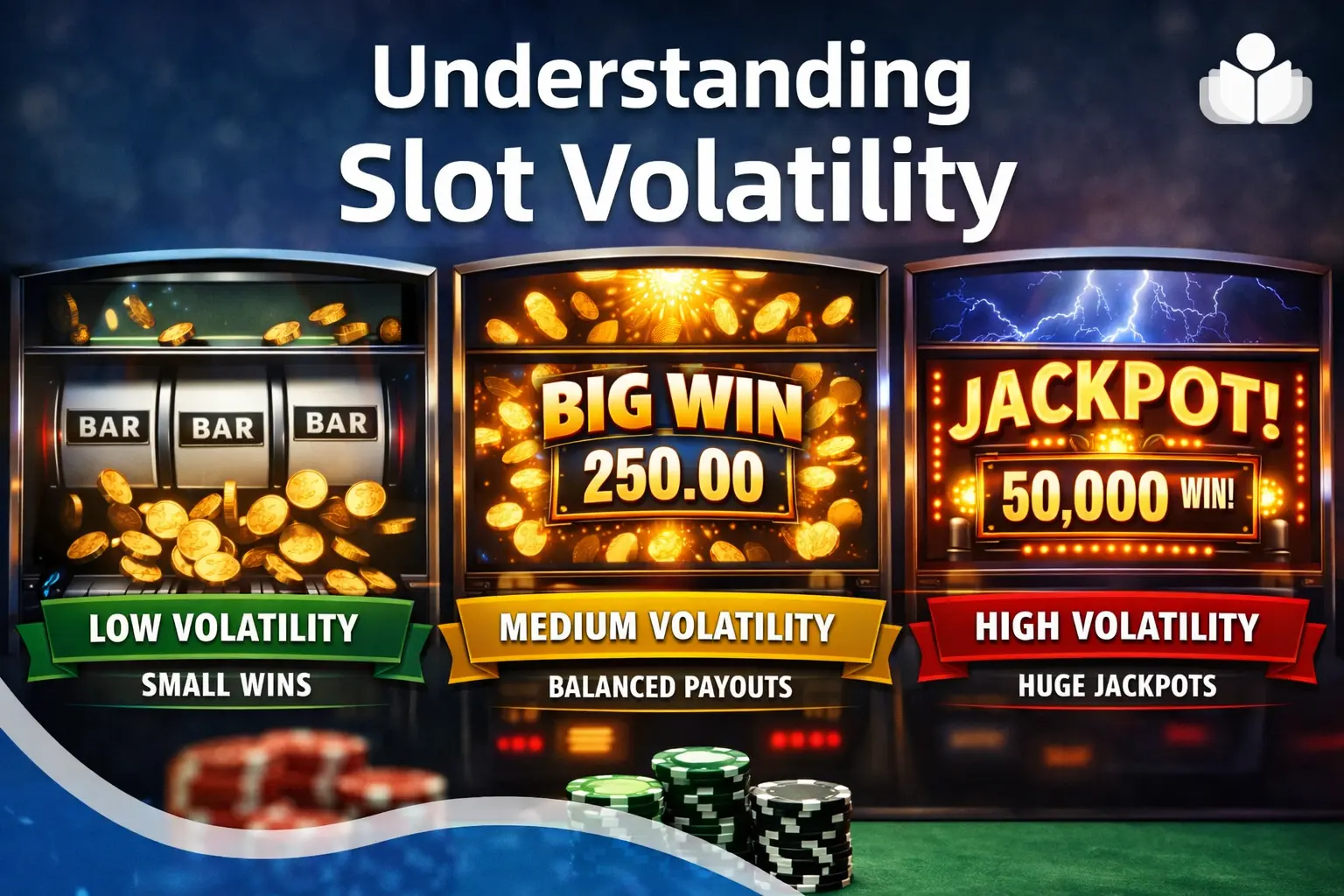
Most slot games are categorized into three primary levels: low, medium, and high. Knowing which category a game falls into will change how you approach your session.
Low Volatility: The Steady Stream
Low volatility slots are designed for players who enjoy frequent action. These games pay out often, but the individual prize amounts are generally small—sometimes even less than the amount you bet on that spin.
- Frequency of wins: High
- Size of wins: Small to medium
- Best for: Players with a smaller budget or those who want to play for a long time without the risk of their balance disappearing quickly.
Medium Volatility: The Middle Ground
Medium volatility slots are the most popular choice for many players. They offer a balance between the frequent small wins of low-risk games and the huge potential of high-risk games. You can expect a mix of small payouts with the occasional “big win” to keep things interesting.
- Frequency of wins: Moderate
- Size of wins: Varied
- Best for: Players who want a bit of excitement and the chance for a decent payout without the extreme “dry spells” of high-risk games.
High Volatility: The “All or Nothing” Experience
High volatility slots are the high-stakes thrillers of the online casino world. These games can go for dozens or even hundreds of spins without paying out a significant amount. However, when they do pay, the rewards are typically much larger than average.
- Frequency of wins: Low
- Size of wins: Large (often including massive jackpots or bonus rounds)
- Best for: Players with a large budget and a lot of patience who are specifically chasing life-changing wins.
Volatility vs. RTP: What’s the Difference?
It is common for beginners to confuse volatility with Return to Player (RTP), but they are two very different concepts.
RTP is a percentage that tells you how much of the total money wagered on a machine will be paid back to players over a very long period (usually millions of spins). For example, a slot with a 96% RTP is mathematically designed to return $96 for every $100 wagered—eventually.
Volatility describes the way that money is paid back.
Imagine two different slots, both with a 96% RTP:
- Slot A (Low Volatility): Returns that 96% by giving you frequent $1 and $2 wins.
- Slot B (High Volatility): Returns that 96% by giving nothing to 99 players and then giving one lucky player a $9,600 jackpot.
Both games have the same theoretical return, but the experience of playing them is completely different.
Why Volatility Matters for Your Bankroll
Your bankroll is the total amount of money you have set aside specifically for playing. Choosing the wrong volatility level for your bankroll is one of the most common mistakes players make.
Managing a Small Bankroll
If you have a limited amount of money to play with, high volatility slots can be dangerous. Because these games have long “dry spells,” it is entirely possible to run out of money before the game ever hits a winning combination. In this case, low or medium volatility games are generally a better fit because the frequent small wins help “recycle” your money and keep you in the game longer.
Managing a Large Bankroll
If you have a larger budget, you have the “stamina” to outlast the losing streaks of a high volatility game. You can afford to spin 200 times without a win in hopes of hitting a massive multiplier or a bonus round that pays out 5,000x your bet.
How to Identify a Slot’s Volatility
Most modern game developers provide a volatility rating in the game’s “Info” or “Help” section. It is often displayed as a star rating (e.g., 4 out of 5 lightning bolts) or a simple label like “High Variance.”
If the information isn’t explicitly stated, you can look for these clues:
- The Paytable: Look at the difference between the payout for four of a kind versus five of a kind. If the jump in value is massive (for example, 10x for four symbols but 500x for five), the game is likely high volatility.
- The Maximum Win: Games that advertise “Max Wins” of 10,000x your bet or higher are almost always high volatility.
- Bonus Features: Slots that pack most of their winning potential into a single, hard-to-trigger bonus round are typically high volatility.
- Jackpots: If a game has a massive progressive jackpot, it is usually high volatility to compensate for that huge top prize.
Which One Should You Choose?
There is no “better” level of volatility; it all depends on what you want out of your session.
- Choose Low Volatility if: You find it frustrating to go more than a few spins without a win, or if you simply want to enjoy the graphics and animations for as long as possible on a fixed budget.
- Choose Medium Volatility if: You want a balanced experience. You’re okay with some losing streaks as long as there is a realistic chance of a “nice” win that is significantly higher than your bet.
- Choose High Volatility if: You are a “jackpot hunter.” You understand the risks, you have the patience to wait, and you find small wins boring.
Summary Checklist
Before you start your next session, keep these points in mind:
- Check the info panel: See if the developer listed the volatility.
- Check your budget: Do you have enough to survive a long losing streak?
- Define your goal: Are you playing for entertainment (low) or for a big score (high)?
- Watch the paytable: Big gaps between small and large wins signal high risk.
By understanding volatility, you take the guesswork out of your play. You won’t be surprised by a long losing streak on a high-risk game, and you won’t be disappointed by a small payout on a low-risk game. You can choose the experience that matches your style and your wallet.
Must be 21+ to participate. Gambling problem? Call 1-800-GAMBLER.